Leveraged Tokens vs Perps on Hyperliquid
Guides
Leveraged tokens vs perps on Hyperliquid
Most leveraged trades do not fail because the trader was wrong on direction. They fail because the position could not survive the sequence of price moves required to be right.
Leverage makes outcomes path dependent. A position can be directionally correct and still fail if margin, leverage, and liquidation risk evolve unfavorably before the move plays out. This is why instruments that advertise the same headline leverage can produce materially different outcomes over time.
To understand this, it is not enough to look at entry leverage. What matters is how leverage and margin behave after the trade begins.
Perpetual futures, single position exposure with a liquidation boundary
A perpetual future is a single margin position with a liquidation price.
When a trader opens a 5x perp, leverage is exactly 5x at entry. A sufficiently adverse move at any point can terminate the position entirely, regardless of whether the market later moves in the intended direction.
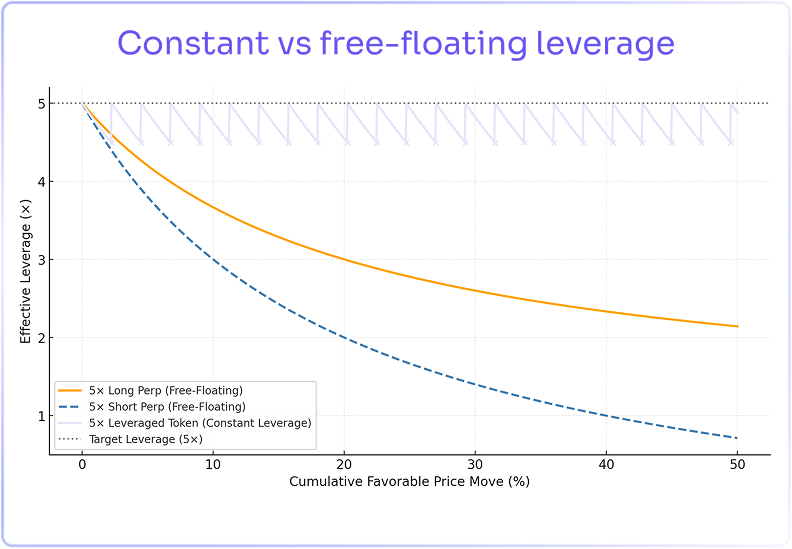
As price moves in favor of the position, unrealized PnL increases margin. As margin increases, effective leverage declines mechanically, and the liquidation price moves further away. The position becomes more resilient to adverse price movement as leverage declines.
The cost of this design is that PnL sensitivity per unit of price movement declines over time. Later legs of a trend therefore contribute less incremental PnL than earlier ones, even though the position size in units remains unchanged.
Leveraged tokens, constant leverage through rebalancing
Leveraged tokens are structured differently.
Rather than maintaining a single position with fixed unit exposure, leveraged tokens periodically rebalance an underlying perpetual position to keep leverage near a specified target. As unrealized PnL changes margin, rebalancing adjusts position size. Unrealized gains increase notional exposure to restore target leverage, while unrealized losses reduce notional exposure to reduce liquidation risk.
This allows the position to survive adverse moves and maintain leverage into later stages of a sustained trend, where a disproportionate share of PnL can be realized.
Trending prices reward constant leverage
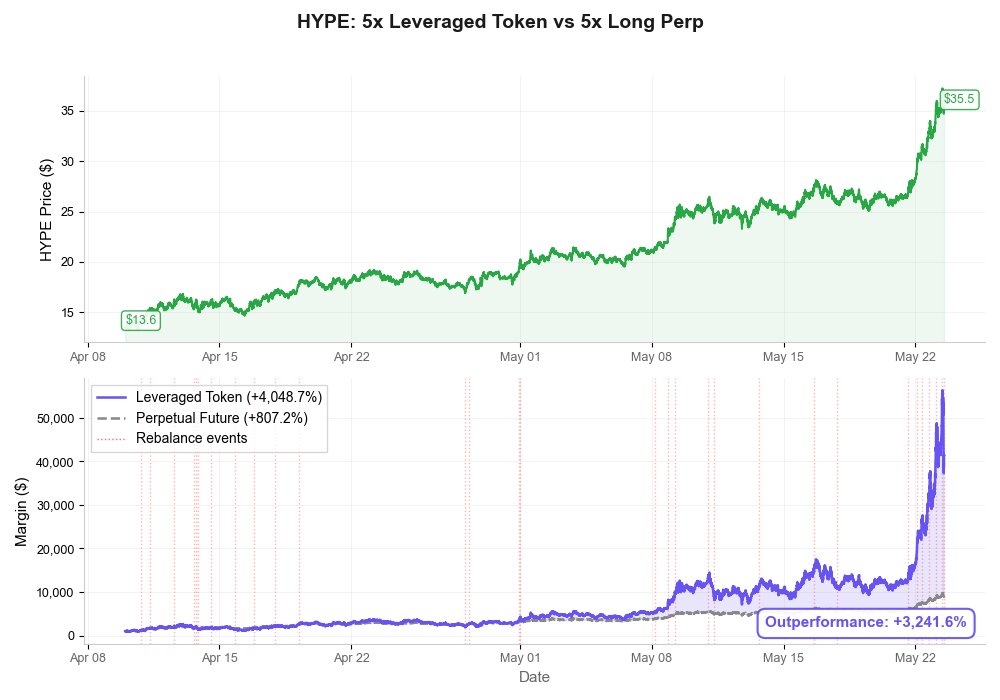
HYPE entered a sustained uptrend over the period, with price appreciating steadily and acceleration occurring in the later stages of the move.
- The 5x long leveraged token maintained leverage near its target through periodic rebalancing. As unrealized PnL increased margin, position size was adjusted to keep effective leverage close to 5x, preserving exposure throughout the trend.
- The 5x long perpetual position de levered as margin increased. By the later stages of the move, effective leverage had fallen to approximately 1.4x, materially reducing PnL sensitivity during the strongest portion of the rally.
- As a result, later legs of the trend contributed disproportionately more PnL to the leveraged token than to the perp position.
Result
- Leveraged Token: +4,048.7%
- Perpetual Future: +807.2%
The difference emerges from how leverage evolves over time, not from differences at entry.
Volatility decay, when constant leverage works against you
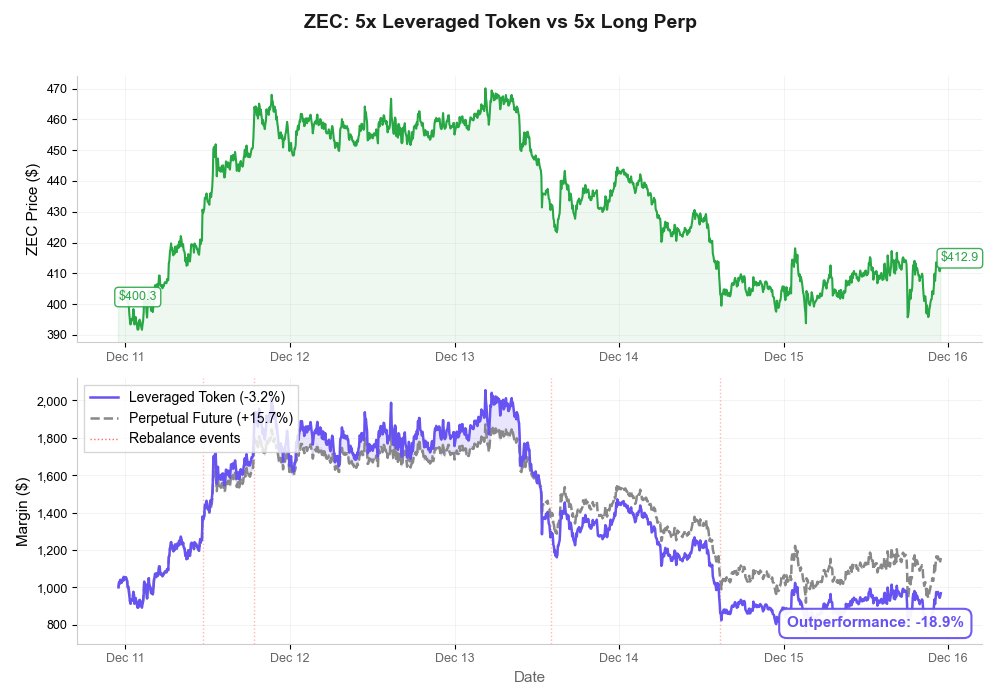
Period, 10 Dec 2025 to 15 Dec 2025, free floating versus constant leverage
This period illustrates volatility decay in practice.
Price oscillated within a relatively tight range without establishing a sustained directional trend. During this regime, the leveraged token repeatedly rebalanced position size in response to unrealized PnL changes, converting volatility into drag.
The perpetual position, by contrast, did not rebalance and therefore did not systematically convert volatility into losses.
Result
- Leveraged Token: -3.2%
- Perpetual Future: +15.7%
Leverage is a structural choice
Perpetual futures and leveraged tokens express leverage in fundamentally different ways.
Perps concentrate risk in a single position with fixed unit exposure, where leverage decays mechanically as margin grows and failure is realized through liquidation. Leveraged tokens maintain target leverage through rebalancing, keeping leverage applied through sustained trends while accepting volatility decay as a tradeoff.
A 5x perp is only 5x at entry. What happens next depends on the instrument you choose.